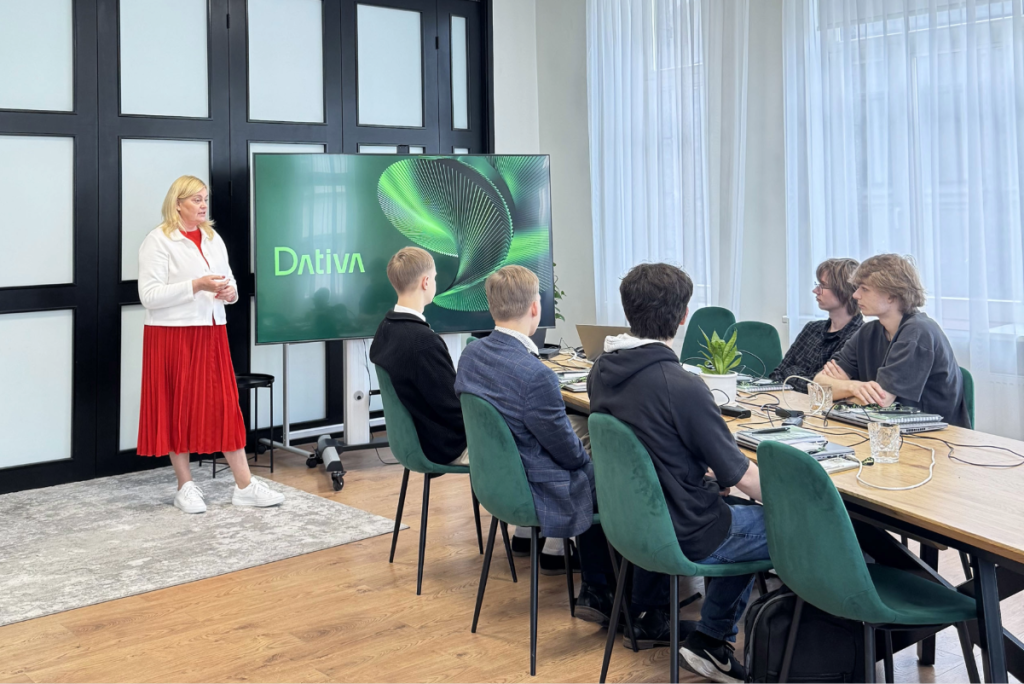


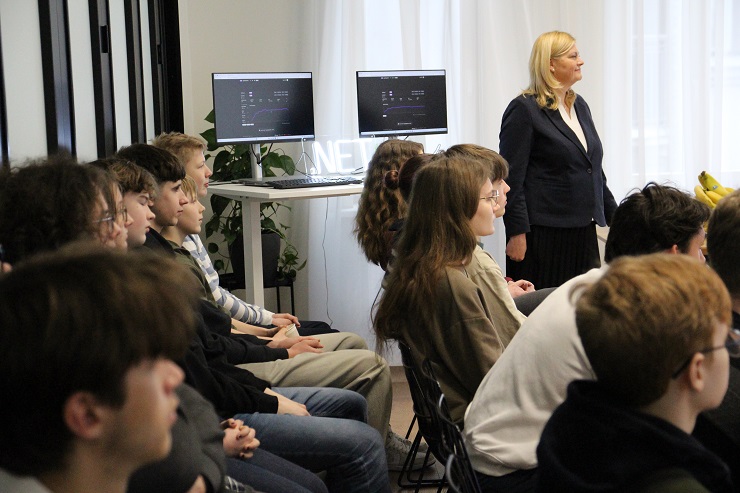
30 students from Riga, Salaspils, Dobele, Jelgava, Saldus, Valmiera, Viļāni, and other towns At the SIA “ZZ Dats” office in Riga’s Quiet Center, this year’s “Shadow Day” provided a closer look at the work of a client consultant, IT project manager, systems analyst, tester, programmer, systems administrator, and lawyer.
“The young people acknowledged that learning about the various IT roles was one of the most interesting activities, as it gave them the opportunity to see how IT solution development takes place at all stages and the IT product implementation cycle as a whole. They appreciated the opportunity we offered to observe the team’s daily stand-up meetings in a project where development follows the Agile methodology.
On “Shadow Day,” we aim to showcase the wide variety of IT professions to better inform the public about IT roles and their diverse responsibilities, as we still encounter the misconception that IT is solely about programming—it’s assumed that if someone programs, they can fix a computer. But these are completely different jobs!
We are delighted that students from a wide variety of Latvian educational institutions see their future in the promising IT sector. It is evident that the youngest of these students are gaining positive experiences in the “Computer Science” course; some attend additional programming classes, while older students are already close to potentially studying and later working in our industry in the near future. This year, too, we received the most applications from students who want to learn about the work of a programmer, but we appreciate that some students are also interested in the work of a systems analyst and an IT project manager. Over the course of the day, the students saw that an IT company employs more than just programmers—many other colleagues are involved in ensuring overall operations, software development, implementation, maintenance, management, and more. For example, the young people who chose to shadow our lawyer were also pleasantly surprised.
We are increasingly encountering students who already know early on that they want to pursue a career in computers. We are particularly pleased with students who are already actively doing and experimenting with things in this field while still in school. There are so many opportunities for self-directed learning these days! We strongly encourage young people to keep this up, because even the smallest bit of experience matters,” says Iveta Kažemaka, Head of Administration and Human Resources at SIA “ZZ Dats.”
One of the young people—a shadow—later said that it was interesting for him to gain insight into the profession at SIA “ZZ Dats”; he realized that to become an IT project manager, one must start by gaining experience in other roles, as this is the only way to gain a full understanding of the IT sector. Another student signed up to shadow a systems administrator, as that is the exact position he wants in the future. He already had a general idea of what to expect from the experience, as he is studying to become a computer systems technician. He is in his second year at the technical college and appreciated the opportunity to gain insight into the company’s day-to-day operations and get answers to questions he had about his chosen profession.
“Shadow Day,” which takes place on April 4 this year, is a globally recognized Junior Achievement career education program for students in grades 1–12, during which students visit a workplace and spend 4–6 hours observing the daily work of a professional in their field of interest.
20.72% of residents receive their property tax payment notices via email, 39.56% via e-mail, while the rest still receive them by mail. In total, local governments have prepared 900,000 payment notices for individuals this year. It is evident that there has been a significant increase specifically in the segment of e-address users, as the number of payment notices delivered to this group in 2026 increased by 12.13 percentage points compared to 2025. Meanwhile, the total number of payment notices delivered electronically to individuals increased by 8 percentage points in 2026.
“The public awareness and engagement initiatives implemented by local governments are valuable, encouraging residents to register to receive property tax payment notices electronically. It is essential to make increasingly effective use of digital opportunities, as we are doing here, saving resources and allocating them to other municipal needs,” says Edžus Žeiris.
On the portal www.epakalpojumi.lv, the property tax e-service is one of the most widely used electronic services in the country, and in 2025 it was used 390,000 times, processing property tax payments totaling more than 21 million euros. By mid-March 2026, the real estate tax e-service on www.epakalpojumi.lv had already been used 143,000 times, with real estate tax payments totaling more than 7 million euros. To avoid missing the payment deadline, property owners are also encouraged to sign up for property tax reminders, which can be done at www.epakalpojumi.lv. Owners who receive their property tax payment notices by mail are encouraged to sign up to receive them electronically via email; this can be done at www.epakalpojumi.lv or by contacting the local government where the property is located.
Please note that if an owner already receives property tax payment notices via email, after registering an official electronic address (e-address), future notices will be sent exclusively to that e-address. To ensure they do not miss messages received at their e-address, residents are encouraged to provide an additional private email address at their e-address to receive notifications about new messages received at their e-address.
The information was prepared using data on property tax payment notices sent to individuals in Latvian municipalities by March 20, 2026.