

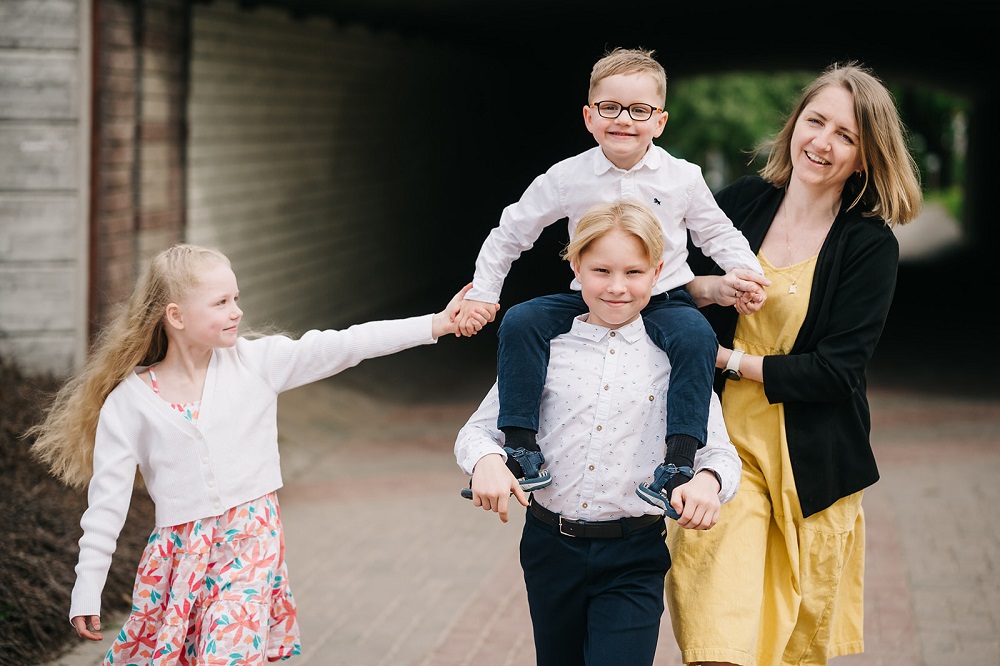
Three mothers working in the information technology sector—Vita Jekimova, Santa Šeļegovska, and Laima Genava—will also receive a warm hug and a kiss on the cheek on Mother’s Day. Although their primary workplace is located at the office of the IT company SIA “ZZ Dats” in Riga’s Quiet Center, they take advantage of the opportunity to work remotely from their homes in Riga and Jelgava on a daily basis. Other SIA “ZZ Dats” employees also choose to work remotely, living not only in Riga but also in other Latvian cities, such as Liepāja, Jēkabpils, Valmiera, and elsewhere. According to all three moms, it is precisely work in the IT sector that offers the opportunity to combine professional growth with motherhood on a daily basis. At work, the most important thing is to get results, so if you need to take your child to practice or the doctor during the day, it’s not an obstacle—working in IT also offers flexible hours.
Balancing daily work in the IT sector with raising children
Vita Jekimova is a project manager at SIA “ZZ Dats,” and her family includes three-year-old Paula and six-year-old Miks. She has been working at the company for over 10 years: “I used to think I definitely wouldn’t work at one company for more than 3–5 years. I had read articles on human resources management that recommended changing jobs every 3–5 years to gain new knowledge, experience, professional challenges, and expand one’s network of contacts; however, I’ve been at “ZZ Dats” for more than 10 years now. I started as a marketing specialist—for several years, I helped develop the company’s image. Two years ago, management offered me the position of IT project manager. I have to admit that I was scared when I received the offer. I remember that the company’s director personally called me and encouraged me to take on this role. Currently, I am involved in the development and maintenance of IT projects.” Vita is pleased that she is able to combine managing projects of public importance with family life and raising children. One of the projects Vita works on daily is the cross-border exchange of e-prescription data with certain member states, so that residents can purchase prescription medications outside Latvia’s borders and vice versa – visitors from other countries can purchase necessary medications here in Latvia.
Vita particularly values the opportunity to work remotely: “This was especially important when the children were younger and got sick more often. If the little ones had a cold and I couldn’t help out at home, I took advantage of the opportunity to work remotely. Likewise, my employer is always understanding if I need to take the children to the doctor during work hours.”
Santa Šeļegovska is a programmer at SIA “ZZ Dats” and has developed information systems for several municipalities. Santa lives in Riga and appreciates that on workdays she can pick up her children from daycare on time. Her family includes six-year-old Kristers and two-year-old Markuss. Santa began working at SIA “ZZ Dats” after completing her studies; she already had work experience gained during that time at another information technology company, and she has been part of her current workplace’s team for 10 years. “I manage to balance work and family well because my workplace offers remote work and flexible hours. If one of the children has a minor illness, I can work remotely and take care of the little patient at the same time. Also, if the need arises, I can step out during work hours to, for example, take a child to the doctor or pick up something necessary, and I can catch up on my work duties later in the evening or earlier in the morning. It’s not mandatory to be at work from 9:00 a.m. to 6:00 p.m., though of course I don’t miss any scheduled meetings, which mostly take place remotely. A workday in the IT sector is essentially similar to those in other sectors where an employee can perform their duties largely independently.”
Meanwhile, Laima Genava, an IS tester and documenter at SIA “ZZ Dats,” has three children: Gustav is 11, Anete is 8, and Matīss is 4. Laima’s previous work experience was in accounting, but her master’s studies in the RTU Business Informatics program helped her change careers; Laima has now been working as a tester-documenter for nine years. Her primary responsibilities include testing the functionality of various applications, analyzing errors, developing documentation, and keeping it up to date. Laima has worked on testing document management and accounting systems currently used by several municipalities throughout Latvia.
Laima admits that being a mom and working a full-time job can be very difficult at times, but she believes the IT sector is supportive of employees with children: “In any case, I don’t feel any negative attitudes or stereotypes at work. At SIA "ZZ Dats," we can work remotely, finish tasks left over from the day in the evenings, and the children can reach us at any time, which gives both me and the children a sense of security. The work is flexible and suitable for new parents.”
Laima’s family lives in the Jelgava region: “On the one hand, the pandemic also brought something good—the opportunity to work remotely and the realization that working this way is possible and is standard practice. I work remotely and go to the office in Riga’s Quiet Center a few times a month. Mornings aren’t so rushed; I can calmly take the kids to school, come back home, and start working. In the afternoon and evening, I don’t have to spend an hour on the road taking the kids to their activities. Time management is very important so that by the end of the day, work is done and other responsibilities are fulfilled.”
According to Vita’s observations, the IT sector is dynamic and ever-changing: “As technology evolves, so do society’s needs and skill levels. Stereotypes about the IT sector were more common 10–15 years ago; for example, people would often ask, ‘Can you reinstall my computer?’ However, over time, the public’s understanding of the IT sector has grown, and most people now know that IT isn’t just about computer network administrators.”
If they grow up in an IT environment, will they become programmers?
When asked whether their children understand their job responsibilities and might want to do something similar in life, the mothers gave varied responses. “My children know that I test how applications work—simply put, whether the programs do what they’re supposed to. I asked them if they’d like to do something similar in life. The answer from all of them was: ‘Maybe… Because I’d like to get a paycheck,’ says Laima about her three children’s potential future career choices.
Vita’s preschool-aged children think the most fantastic profession is a salesperson at a toy store, even though she has told the children what she does and what projects the company is working on: “The children were fascinated by the story of the creation of a registry for unmanned aerial vehicles (drones), which was developed by one of the ‘ZZ Dats’ teams.”
Six-year-old Kristers knows a little about his mom’s work, but Santa says her son is still too young to understand the IT industry and find what she does at work interesting.
Quality time spent together in our free time
Santa spends her free time with the children going for walks, at playgrounds, or riding bikes: “We also enjoy cooking together or playing a computer game. Most of my free time revolves around the kids, and right now, while they’re still little, we’re enjoying it together!”
Meanwhile, Laima’s kids do folk dancing in their free time, and Gustavs plays hockey, so weekends are pretty busy for the family: “If we can, we like to go outside, visit playgrounds, go swimming, or go to the movies—we try to capture that vacation feeling. I have very little free time myself, but I spend what little I have reading books or exercising.”
Vita is grateful to her husband, with whom she shares the daily responsibility of taking the children to and from school and driving them to sports practice. Since our son is into BMX, we go to one of the “pump-track” bike courses on the weekends.
How do the children celebrate Mother’s Day?
Every year, Laima attends concerts dedicated to mothers, where the children give homemade greeting cards and present flowers: “It’s nice to receive greetings, so yes, I’m hoping for at least a warm hug and a kiss on the cheek this year too!”
Vita’s children celebrate Mother’s Day with flowers: “We go on a family outing together and visit our grandmothers. Shortly before Mother’s Day, the preschool my children attend organizes a ‘date’ between the child and mom. It’s very touching to go on a date with my little one. On this day, the children take care of Mom—they ask what she’d like—tea or coffee—and bring her the drink of her choice on a tray. With the teacher’s help, the children have prepared the treats themselves. It’s just the two of us at the table. We sip our drinks undisturbed and chat. Very heartfelt and touching!”
Meanwhile, Santa’s children, together with their dad, prepare a surprise for her every year on Mother’s Day: “For several years now, my oldest child has been drawing and writing a greeting card for me on their own. The sweetest greeting was the mini Mother’s Day concert they put on at home.”
In 2024, Mother’s Day in Latvia will be celebrated on May 12.